Australian physicists use gravity to send a message through a brick wall
University of Queensland physicists have demonstrated a gravity-based communication method by sending a binary message through a brick wall using a vintage elevator.
By Justin Barnes ·
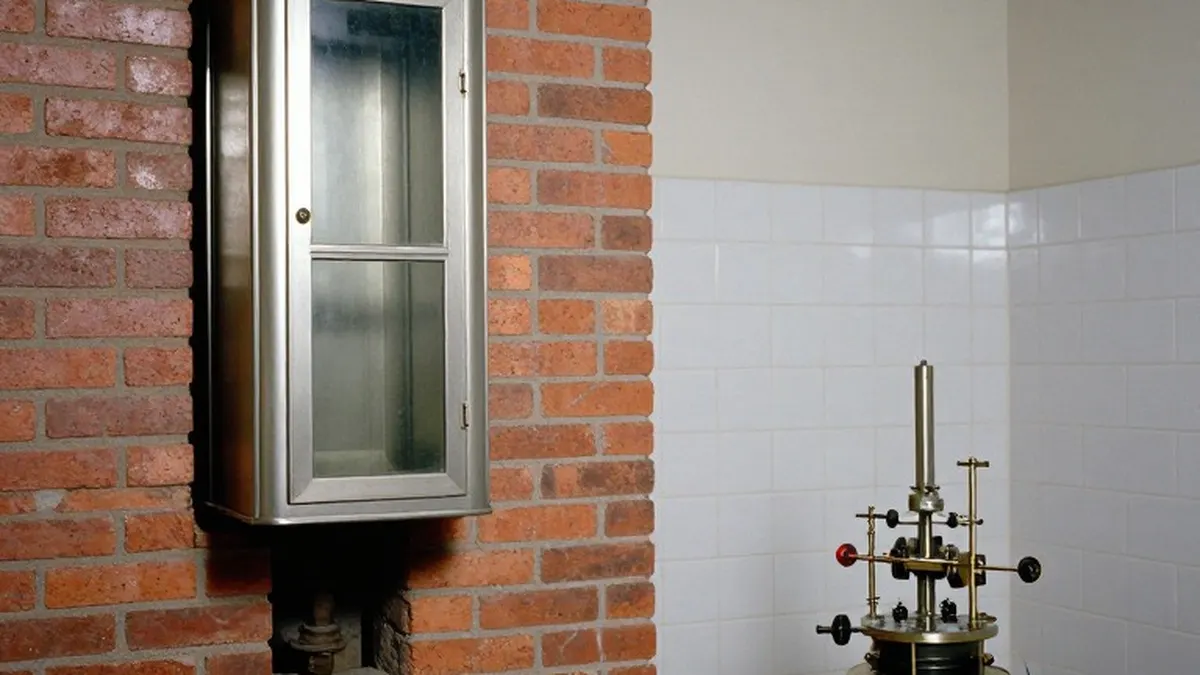
Researchers at the University of Queensland have successfully demonstrated a novel method of communication that relies on gravitational forces rather than electromagnetic waves. In a proof-of-concept experiment, the team transmitted a message approximately 70 centimeters through a solid brick wall by manipulating the position of a heavy object. The study, published in the journal Science Advances, highlights a technique that the scientists describe as practically unblockable because it does not require a clear line of sight between the sender and the receiver.
The experimental setup utilized a 1950s elevator located in the university's Parnell physics building. The device was positioned to move between two floors, and a sensitive instrument known as a gravimeter was installed in a men's bathroom adjacent to the lift shaft. This gravimeter was designed to detect minute changes in the local gravitational field caused by the movement of the elevator's 1.8-tonne counterweight. By monitoring these shifts, the researchers were able to interpret the vertical position of the counterweight as binary data, with one floor representing a zero and the other representing a one.
The team chose to transmit the word gravity, which translates to a specific sequence of binary digits. Due to the limitations of the current detection technology, the transmission rate was limited to one bit per minute. Consequently, sending the single word took nearly an hour to complete. While this speed is significantly slower than modern digital communications, the core advantage of the method lies in its ability to penetrate dense materials that typically block radio waves, such as concrete, metal, or brick.
Dr Charles Woffinden, a co-author of the study from UQ's school of mathematics and physics, explained that gravitational signals cannot be screened out by ordinary materials in the way electromagnetic signals can. He noted that anyone who has experienced poor phone reception in a tunnel or difficulty with wifi through a thick wall would appreciate the potential appeal of this approach. Unlike standard wireless communication, which relies on electromagnetic fields that are easily absorbed or reflected, gravity passes through most matter almost unimpeded.
Prof Matthew Davis, another co-author, acknowledged that the method is currently far from practical for everyday use. He stated that it is difficult to imagine how it could be practically useful at this stage, but emphasized that the experiment was theoretically interesting enough to warrant the effort. Davis pointed out that the current speed is so slow that Nasa's Voyager 1 spacecraft, which has been traveling for 49 years and is now one light-day away, can communicate with Earth at a faster data rate than this new concept.
The idea for the experiment originated from a separate project aimed at developing a contactless weighbridge. That project sought to use quantum sensors to detect changes in gravity caused by passing trucks, thereby determining the mass of large vehicles without physical contact. The elevator experiment served as a side application of this research, allowing the team to test the sensitivity of their detection methods in a controlled environment.
Davis explained the underlying physics by comparing classical gravimeters to a mass on a spring. When the gravitational field changes slightly, the rate at which the mass bounces changes accordingly. While quantum sensors, which could potentially improve the range to 500 meters and increase the speed by 15 times, are still under development, the current results provide a solid foundation for future exploration.
Other methods of communication, such as those using neutrinos or gravitational waves, have been proposed in the past. However, the scientists noted that these approaches are often hindered by the difficulty of generating a measurable signal. The elevator experiment offers a simpler, albeit slower, demonstration of the principle. The research was conducted in the same building that houses the world's longest-running science experiment, the pitch drop experiment, which began in 1927, adding a layer of historical significance to the quirky nature of the new study.