Andreas Nieder's crows beat monkeys on visual tasks
A new study shows birds use the same mathematical logic as primates for decision-making, despite lacking a neocortex.
By Justin Barnes ·
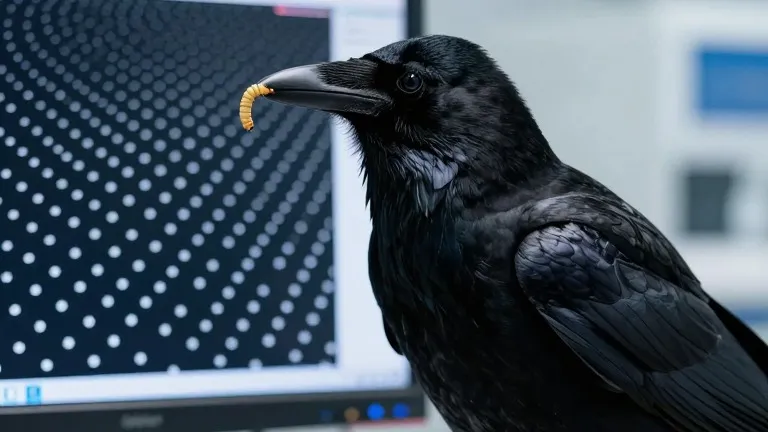
Carrion crows solve visual ambiguity tasks at twice the speed of primates, according to a new study published by researchers at the University of Tübingen. The findings demonstrate that birds reach decisions using the same underlying mathematical logic as monkeys, even though their brains lack the neocortex found in mammals.
The experiment utilized the random-dot-motion task, a standard tool in neuroscience. In this test, a cloud of flickering specks drifts weakly in a specific direction. The subject must identify if movement exists and determine its direction. In primates, neurons in the neocortex collect visual evidence over time. Their firing rates increase until they cross a threshold, triggering a final choice. Because birds do not possess a neocortex, scientists were uncertain how avian brains process similar information.
Andreas Nieder, a neurobiologist at the University of Tübingen, noted that determining how a differently organized brain encodes decisions was a major open question. He and colleague Philipp Schmidbauer conducted the study to answer this. They trained two hand-raised carrion crows to perform the task. The birds sat before a touch-sensitive monitor displaying white dots on a black background. The crows indicated the direction of motion by pecking a target adjacent to the display. A correct response resulted in a mealworm reward.
The researchers designed the setup to be identical to the version used with monkeys, except for the method of response. Monkeys indicate their decision through eye movements, while the crows used pecks. The team varied the difficulty of the task by adjusting the percentage of dots that moved coherently. At the easiest setting, 81 percent of the dots moved in the same direction. At the hardest setting, only 3 percent moved coherently, making the signal barely distinguishable from noise. The team also included a condition where zero percent of the dots moved, providing no correct answer.
The data showed that the crows employed the same decision-making strategy as primates. They accumulated evidence over time before committing to a choice. However, the birds completed the task in approximately half the time required by monkeys. This speed advantage suggests that the absence of a neocortex does not prevent a brain from arriving at decisions through a comparable computational process. The results offer new insight into how different neural architectures can achieve similar cognitive outcomes.
Source: Ars Technica