Bomb Threats Disrupt European Flights and Media Outlets
Dozens of aircraft faced security checks and diversions while Irish broadcasters were evacuated, in a coordinated wave of hoaxes with no confirmed culprit.
By Justin Barnes ·
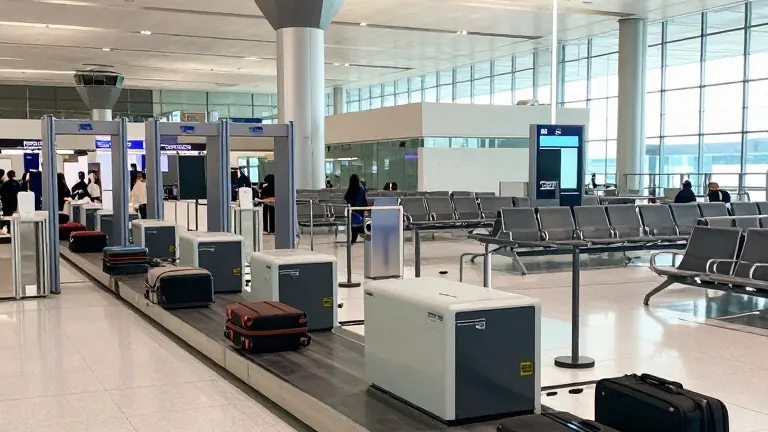
Passengers across Europe faced delays, diversions, and evacuations on Friday as a fresh series of bomb threats targeted commercial flights and media organizations. The incidents extended a pattern of disruptions that began earlier in the week, causing logistical friction for travelers and employees while no injuries or suspicious items were found.
Hungarian Defense Minister Romulusz Ruszin-Szendi stated that military fighter jets escorted three passenger planes through the country's airspace within one hour. He identified the affected routes as flights traveling from Brussels to Sofia, and from Prague to Cyprus and Romania. In France, the office of Prime Minister Sebastien Lecornu reported four new threats against aircraft over French territory. Those planes landed at Paris Orly Airport, where bomb disposal teams conducted inspections.
Further incidents included a Tarom flight from Prague to Bucharest and a Ryanair service from Lisbon to Rome, both of which passed security checks without finding explosives. A WizzAir flight from Prague to Rome diverted to Venice after a bomb alert, leading to the evacuation of passengers upon landing. Police searches at Venice found no threats, though air traffic was briefly suspended during the process.
At Prague's Vaclav Havel Airport, spokesperson Denisa Hejtmankova confirmed nine flights were threatened, including arrivals from Denmark, Spain, and Britain, and departures to the Netherlands, Cyprus, Romania, Italy, and Britain. Czech police described the impact on normal operations as minimal. In Copenhagen, police visited the airport for a second consecutive day as a precaution, assessing that there was no danger to passengers.
Authorities have not identified the source of the hoaxes or linked them to a specific state. Some messages claimed to come from a group called the Male State, a far-right Russian movement, while others contained misogynistic language. AFP reported that it had not verified any link between the group and the threats. On Thursday alone, at least 27 flights were targeted, forcing diversions and prompting fighter jets to escort or intercept several aircraft.
The disruption extended to Irish media on Friday, with national broadcaster RTE, Virgin Media, Newstalk radio, and The Irish Independent receiving bomb threats. The Irish government described the hoaxes as likely part of a coordinated campaign of disruption. Police evacuated staff, including Newstalk host Claire Byrne, who returned to air after being advised the warning was a hoax. The government stated that police were working with military, cyber, and aviation authorities to identify those responsible.
Irish Prime Minister Micheal Martin noted that the threats demonstrate how simple it can be to cause disruption through unconventional activities designed to cause fear. He said a significant security operation would be in place next week when Dublin hosts meetings of the European Political Community and European Union leaders.
Recent days have seen similar disruptions affecting the region. An Israel-bound KLM flight from Amsterdam to Tel Aviv landed in Bucharest for a technical stop before receiving a bomb threat, prompting a pyrotechnic inspection. On October 18, an Austrian Airlines flight from Tel Aviv to Vienna diverted to Sofia after a threat, with Bulgarian fighter jets escorting the aircraft. Additionally, the Israeli-operated cruise ship Crown Iris was held at the Greek island of Syros after a claim that an explosive was attached to its hull, leading to the evacuation of 940 passengers and 597 crew members during a search that found no device.