Chadian Army Escalates War in Tibesti Mountains Over Gold and Antimony
Clashes in Miski have killed dozens as troops fight to control mining sites that feed a weapons corridor to Sudan.
By Yuki Melnyk ·
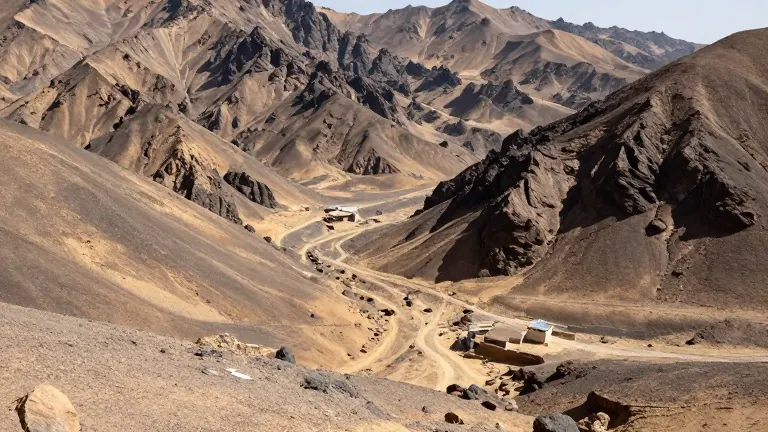
Fighting broke out in the town of Miski on October 14, pitting the Chadian army against a local Tubu self-defence committee in the Tibesti mountains. The conflict centers on control of gold and antimony deposits that have fueled regional tensions for decades. The army accused the committee of breaking a peace agreement by attacking the National Brigade for the Control of Mining Activities. In response, the committee claimed the brigade fired first and opened new mining fronts on grazing land in violation of the Bardai peace accord.
The Chadian army issued an ultimatum to the Tubu group, demanding they lay down their arms or be treated as rebels. The group rejected the order, leading to sustained combat in the rugged terrain. A Tubu commander noted that Chad exported over $1 billion worth of gold and more than 15,000 tonnes of antimony from the Tibesti last year. Almost all of the gold is sold in the Dubai market. The commander pointed out that despite this wealth, Miski has no clinic and the entire Tibesti region lacks a paved road.
Since the clashes began, the Chadian military has deployed significant numbers of troops and armored vehicles to the area. A Chadian army officer described the conditions as difficult, stating that they are fighting the mines and the mountains. The army has also conducted multiple drone strikes across the range. Scores of people have died in the fighting. The region serves as a critical part of an arms corridor that United Nations investigators say has moved weapons from the United Arab Emirates through Libya and Chad to the Rapid Support Forces in Sudan.
Between October 2024 and the end of 2025, heavy cargo aircraft made 458 flights between UAE military airports or the base in Bosaso, Somalia, and eastern Libya. Of those flights, 239 landed at Kufra, a town roughly 300 kilometers from the Sudan border. Kufra was transformed into a logistics hub with new hangars and scheduled flights before the RSF took el-Fasher in October 2025. The UAE also used Amdjarass in eastern Chad to land cargo planes. Senior Egyptian army sources indicated that Emiratis operate a military room inside Amdjarass airport to coordinate with the RSF.
In November 2025, Chad and the Libyan Arab Armed Forces, backed by the UAE, formed a joint border force covering about 1,050 kilometers of shared frontier. The LAAF is de facto commanded by Saddam Haftar, son of Khalifa Haftar. Analyst Jalel Harchaoui said the initial deal was designed to cover the northeastern corner of Chad to secure the eastern Libyan corridor. The agreement also aimed to please the UAE, as Saddam Haftar and Chadian President Mahamat Idriss Deby do not get along. The Tubu were not part of the initial planning for this security arrangement.
The joint force recently moved westward after Saddam Haftar encountered trouble with armed Tubu groups like the Southern Liberation Operations Room, led by Mohamed Wardougou. Wardougou’s group uses northern Niger as a base to fight against Haftar’s forces. On July 20, 2026, photographs showed Chadian soldiers at Libya’s Wigh airbase near the Nigerien border. On October 20, the LAAF arrested Hassan Soukaya, a former Chadian minister and senior opposition figure, as he tried to cross from Libya into Niger. The LAAF handed him to the Chadian army. Niger’s government later accused the Chadian military, with alleged French support, of a drone strike on October 24 near the Salvador Pass that killed two civilians by accident.
On October 14, the same day fighting started in Miski, Libya’s attorney general in Tripoli announced he was prepared to strip 28,000 families registered in Murzuq of their Libyan nationality. The majority of Libya’s Tubu are registered through that civil registry, meaning most would become stateless if the decision is carried out. Tubu communities in Libya report that they are being treated as second-class citizens, with difficulties obtaining passports and IDs. A member of the Tubu defence committee stated that they do not want to be part of a bigger game, but seek peace, justice, and transparency in mining.