Halloween's Celtic Roots: The $13.5 Billion American Tradition
U.S. consumers are set to spend $13.5 billion on Halloween this year, a figure that dwarfs British spending despite the holiday's origin in ancient Scotland.
By Justin Barnes ·
American shoppers will spend $13.5 billion on Halloween in 2026. That total represents roughly three times the per capita amount spent by British consumers, who will spend $940 million on the same date. The gap reflects a commercial structure that has grown around a holiday with few traditional obligations.
Koen Pauwels, a distinguished professor of marketing at Northeastern University, attributes the spending difference to marketing infrastructure and social meaning. He noted that the holiday lacks religious requirements, mandatory family dinners, or required gift-giving. This flexibility allows Americans to extend the celebration to adults, pets, and elaborate home decorations.
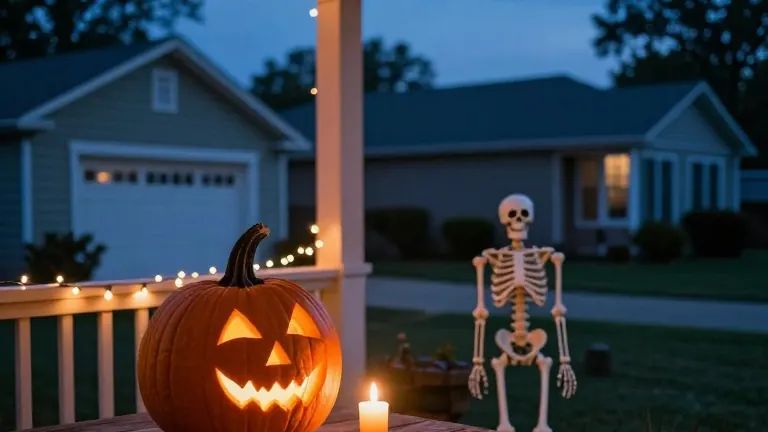
In many U.S. neighborhoods, front yards feature plastic skeletons and paper-mache witches. These displays often cover houses in synthetic cobwebs. The visual spectacle is a modern evolution of practices that date back more than 2,000 years to the Celtic culture of Scotland, Ireland, Wales, and northern France.
The ancient holiday, known as Samhain, fell between October 31 and November 1. It marked the end of the harvest and the beginning of the darker half of the year. The Ulster Folk Museum in Northern Ireland states that Celts believed the boundary between the living and the dead was thinnest during this time. To influence the spirits, people lit massive bonfires.
Victoria Millar, a curator at the Ulster Folk Museum, described the historical atmosphere. She said archives contain chilling stories that entertained, warned, or protected households. Participants wore masks and shared tales of ghosts, fairies, and the devil. Food played a central role in the observance. Bakers prepared apple pies and barmbrack, a fruit bread, with hidden charms inside. A ring, coin, or thimble inside a slice could predict marriage, wealth, or misfortune.
Costuming has a practical origin in these early traditions. Celts dressed up to hide from evil spirits. The specific association of Halloween with witches emerged later, following the witchcraft craze in 17th-century Europe. During that period, religious authorities accused thousands of women of witchcraft and burned them at the stake.
Trick-or-treating also stems from Celtic customs. People dressed as spirits and went door to door to beg for food. They threatened households with curses if they were refused. Francis Blessington, a professor of 17th-century English literature at Northeastern University, explained that people did anything to appease the dead or remove evil influences.
As the Roman Empire expanded into Celtic territories around the 1st century AD, Samhain began to blend with Roman festivals like Feralia. Later, Christianity aligned these older celebrations with Allhallowtide. This three-day observance includes All Hallows' Eve on October 31, All Hallows' Day on November 1, and All Souls' Day on November 2.
The Reformation in 16th-century Britain pushed All Hallows' customs to the margins. Bonfire Night eventually took over the role of the main autumn fire festival. It commemorates the failed 1605 attempt to blow up Parliament. In the 19th century, Irish and Scottish immigrants brought many customs to North America. They adapted the Irish myth of Stingy Jack, who roamed the world with a candle in a turnip. In America, people switched to carving the more plentiful native pumpkin.
Halloween gained commercial momentum in the mid-20th century. Towns organized trick-or-treating in the 1930s and 1950s to reduce vandalism. Postwar suburbs provided walkable streets and front porches that supported neighborhood rituals. Pauwels noted that the holiday found an open commercial slot between back-to-school sales and Christmas. Candy makers and retailers built an ecosystem around this gap. U.K. spending has grown steeply as American films and television popularized the traditions. However, Britons have not fully adopted the habit of outdoing neighbors with large lawn decorations, a practice Pauwels describes as distinctly American.
Source: Northeastern Global News