Medieval Armor Fragments Unearthed in 15th Century Danish Warship Wreck
Researchers have uncovered rare copper-alloy chain mail fragments during a recent survey of the Gribshunden, a 15th-century Danish warship that sank in 1495.
By Yuki Melnyk ·
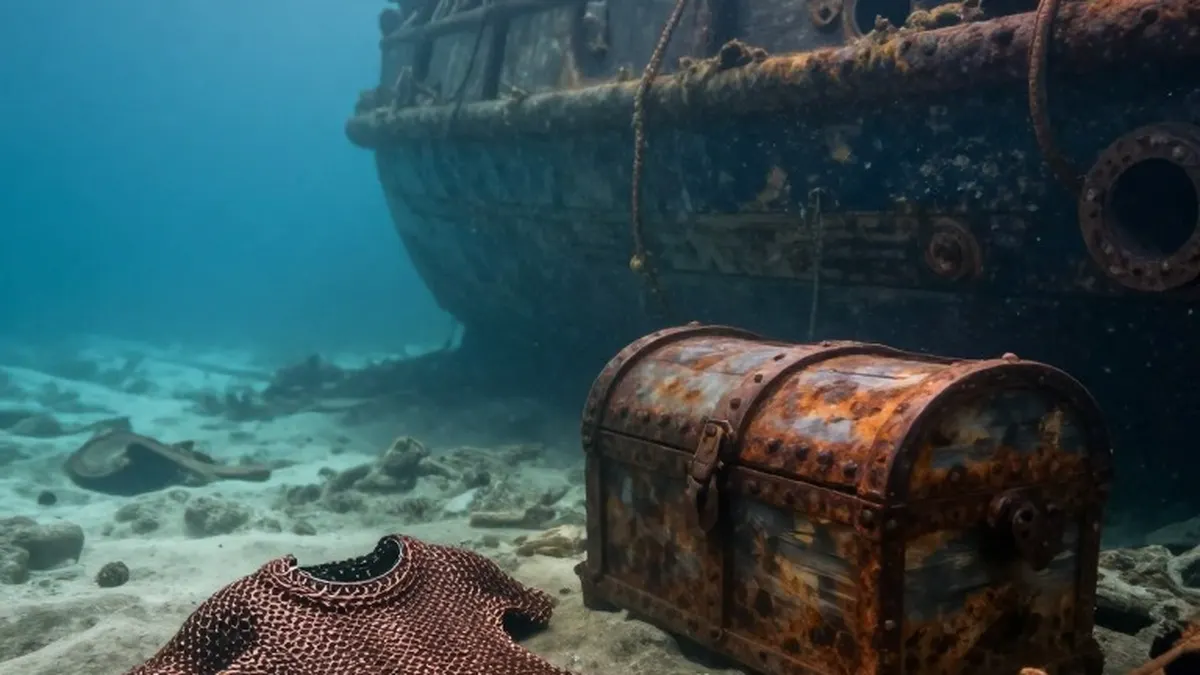
Maritime archaeologists have announced the discovery of high-quality medieval armor fragments within the remains of a 500-year-old Danish warship. The international team of researchers revealed the findings on Tuesday, marking a significant addition to the historical record of the vessel known as Gribshunden.
Gribshunden served as the warship for King Hans, the 15th-century leader of Denmark, and was also utilized for diplomatic expeditions. The ship met its end in 1495 when an explosion caused a fire that led to its sinking while anchored north of Sweden's Stora Ekö Island. Although the wreck was first identified in the 1970s, it has been the subject of continuous study for several decades.
The latest discoveries were made by a collaborative team from the University of Southampton in the United Kingdom, along with Södertörn University and Stockholm University in Sweden. These institutions have been conducting joint expeditions at the site since 2019. According to a news release from the University of Southampton, the team employed advanced robotic survey technology and 3-D photogrammetric imaging to create detailed records of the wreckage.
The armor fragments, which are made of copper alloy, were located while the team was documenting an ammunition-tool chest situated just below the ship's forecastle. This area served as an elevated fighting platform at the front of the vessel. Dr. Rodrigo Pacheco-Ruiz, a visiting fellow at the University of Southampton's Centre for Maritime Archaeology, noted that military gear was likely stored in this specific section of the ship.
Pacheco-Ruiz explained that German mercenaries, known as Landsknechts, were aboard Gribshunden when it sank in 1495. He described the discovery in the news release as truly an amazing find, highlighting the rarity and quality of the preserved materials.
Rolf Fabricius Warming, a Ph.D. researcher at Stockholm University and a Southampton alumnus, suggested that this type of armor was designed for use over extended periods. He noted that the equipment could be repaired or reused by other soldiers, meaning the fragments may represent older military items that were still active at the time of the sinking.
The researchers plan to analyze the manufacturing techniques and composition of the armor to determine its origin. They have also sampled other weaponry-related artifacts from the ship for further study. Additionally, the team will examine the structural elements of the forecastle to understand how weapons were stored and how military personnel lived and worked aboard the vessel.
Other items undergoing analysis include lead objects recovered during previous expeditions, which may be related to molds used for ammunition manufacturing. Samples of lead and other materials were also taken from the tool chest. While the wreck is partly disintegrated, the remaining pieces are described as very well preserved.
In 2024, Warming stated that the ship is a crucial piece of the puzzle regarding the military revolution at sea during the Early Modern Period. This era was defined by a shift in primary tactics from hand-to-hand combat to heavy naval artillery fire. The Gribshunden is considered comparable to other preserved wrecks, such as the Mars and the Vasa, the latter of which has been on display in Stockholm since the 1960s.
More News · National news · Report a business · Got a Story?