Pentagon releases new UAP files revealing contractor plans for secure Nevada vault
Newly declassified documents detail a 2009 proposal for an underground facility to store exotic materials and include recent radar data from high-speed anomalies.
By Yuki Melnyk ·
The Department of Defense released a new collection of files concerning unidentified aerial phenomena on Friday. Among the 43 documents is a report from a government contractor that outlined plans for a secure underground vault designed to store exotic materials and recovered hardware. The release marks the eighth batch of such records made public by the Pentagon.
The specific report in question was produced in July 2009 by Bigelow Aerospace Advanced Space Studies, or BAASS. This organization operated as part of a Defense Intelligence Agency program that Congress funded to investigate potential future aerospace threats. The initiative was championed by then-Senator Harry Reid. The 538-page document identified a need for a highly secure facility to hold biological samples and hardware from private individuals and corporate entities, including groups located in Brazil.
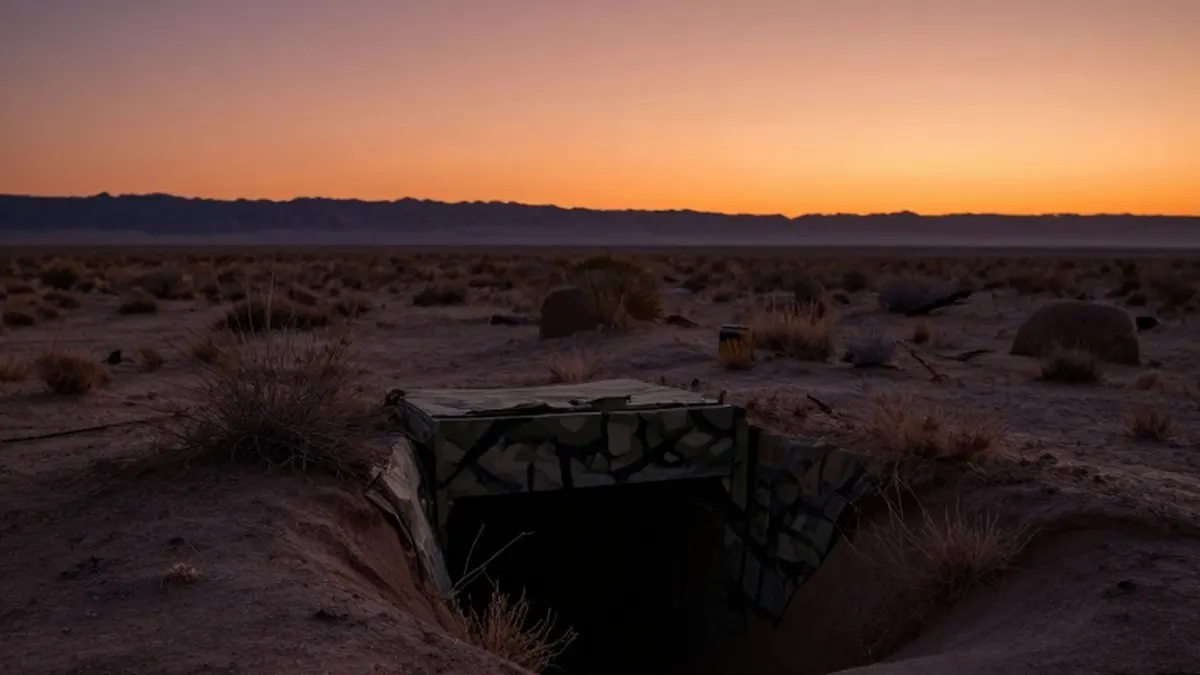
According to the text, the BAASS administrator recognized that the organization lacked a secure facility to store the exotic material or tissue it might acquire. Consequently, a design was created for an underground facility at the Bigelow Aerospace location in North Las Vegas. The plan called for the structure to be buried under 15 to 20 feet of dirt. The vault itself would measure 5,000 square feet and feature walls three feet thick, protected by a heavy steel door. Any surface structures would be extensively camouflaged to blend with the surrounding area.
There is no public record indicating that this vault was ever constructed. Subsequent reports from BAASS that the Pentagon has released do not mention the facility. A few months after the initial report, a Defense Intelligence Agency official described the company's findings as having limited value. The Pentagon's research project concluded in 2012, and the parent company, Bigelow Aerospace, laid off its entire workforce in 2020.
Although a copy of the BAASS report appeared online last year, Friday's release represents the first time the Pentagon has officially made the document public. The new batch also includes files and videos of more recent encounters. Three clips submitted to the Pentagon's All-domain Anomaly Resolution Office show white dots moving across the screen, capturing activity observed by the military.
Another file details strange detections recorded by a civil air-surveillance radar in 2023. The system picked up eight detections over a period of 84 seconds at altitudes between 55,000 and 70,000 feet. The Pentagon noted that if these detections were linked to a single continuous track, the cumulative displacement would be approximately 38.5 miles. This would yield a minimum mean horizontal ground speed estimate of 1,650 mph. However, the available data was deemed not sufficient to confirm that all eight detections were caused by the same object.
The release also contains historical documents from the Air Force and CIA dating back to the 1950s. One notable account from 1953 was provided by Clarence Kelly Johnson, the chief engineer at Lockheed who later designed the U-2 and SR-71 spy planes. Johnson reported to the Air Force that he observed a dark, elliptical object hanging motionless against a gold and red sky while watching the sunset at his California ranch.
Johnson wrote that he wondered why the object appeared so dark despite the sun being behind it. He initially thought an aircraft had created an intense smoke trail but studied the object closely through binoculars. He noted that the outline of the object did not change during his observation. Eventually, the object sped off in a long shallow climb. Around the same time, a Lockheed test crew flying offshore reported chasing what appeared to be a very large flying wing that shrank to a mere speck.
An Air Force record included in the file categorized this 1953 sighting as a lenticular cloud. The inclusion of this historical data alongside recent radar anomalies provides a broader context for the ongoing investigation into unidentified aerial phenomena by the U.S. government.
More News · National news · Report a business · Got a Story?