Port Jefferson's $5.5 Million Bluff Wall Faces Funding Gaps and Erosion Threats
New drainage systems and a 15-foot safety margin define the final Phase 2 design, which requires FEMA approval before bids can be issued for a project targeted to start in late 2027.
By Elena Greco ·
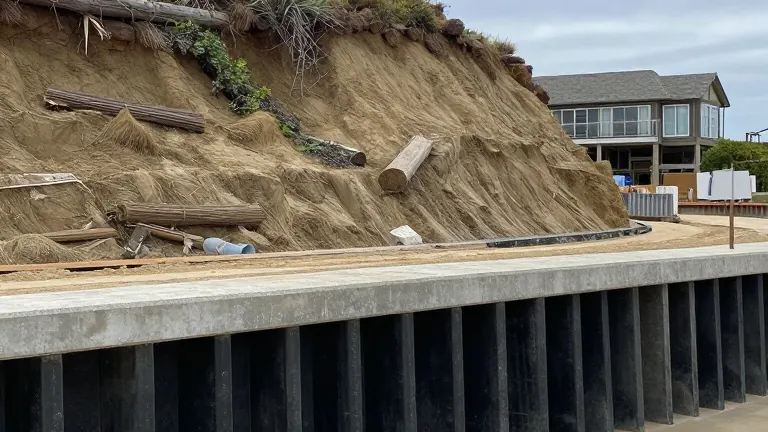
The Village of Port Jefferson has finalized the engineering design for the second phase of its East Beach bluff stabilization project, a move that locks in a construction estimate of $5.5 million while leaving key funding sources unresolved. Engineers from GEI Consultants presented the signed and sealed plans to the village Board of Trustees on Nov. 9, concluding a multi-year process of technical review and revision.
The upper wall design incorporates a sheet-pile structure with a concrete cap and an underground anchoring system. A new drainage system is included to manage stormwater runoff from the adjacent Port Jefferson Country Club, a change intended to reduce the volume of water reaching the bluff face. GEI senior engineer Kevin Ang noted that the wall is engineered for an exposed height of 15 feet, providing a safety buffer in case the bluff crest continues to erode.
Ang stated that the primary function of the upper wall is to retain the land supporting the country club’s foundation. He explained that the combined system of the upper wall, the completed lower wall, and vegetated slopes aims to mitigate further erosion. Construction inspection will focus on monitoring vibrations during installation to prevent damage to the nearby clubhouse.
Village officials and residents remain concerned about erosion at the bluff toe, particularly west of the existing lower wall. A nor'easter in late September displaced several feet of the bluff base and moved coir logs used for terracing. Trustee Matthew Franco reported that some logs had been found 90 to 100 feet down the beach. Trustee Bob Juliano asked if continued erosion at the toe would compromise the new upper wall, to which Ang responded that the design includes specific contingencies for such conditions.
The project’s financial structure relies on municipal borrowing, the village general fund, and federal grants. The village has already borrowed $5.2 million under a $10 million bond authorization approved in 2021. Total costs for the first phase, completed in 2023, reached $6.02 million. For the second phase, a Federal Emergency Management Agency grant is expected to reimburse up to $3.75 million, provided the revised design receives approval.
Village Treasurer Stephen Gaffga reported that the village has spent nearly $882,000 on engineering, oversight, and monitoring since 2017. This total includes approximately $638,000 for Phase 1 work and additional expenditures for Phase 2 analysis through Nov. 10. Village supervisor Sheprow indicated the village has applied to New York State for an additional grant of nearly $1 million, though the outcome remains pending.
Before construction bids can be released, the village must secure FEMA approval and confirm all funding streams. Sheprow estimated that construction for the upper wall is expected to begin between late fall 2027 and early winter 2028. Officials are also exploring the possibility of extending the lower wall westward, a project that Sheprow estimated would cost an additional $4 million to $5 million.
More Business · Scam Watch · Report a business · Got a Story?