Trump and Xi meet in Shenzhen with limited expectations for trade breakthroughs
US and Chinese leaders gather in Shenzhen for a brief summit where analysts predict a focus on stability rather than major new agreements amid ongoing rivalry.
By Yuki Melnyk ·
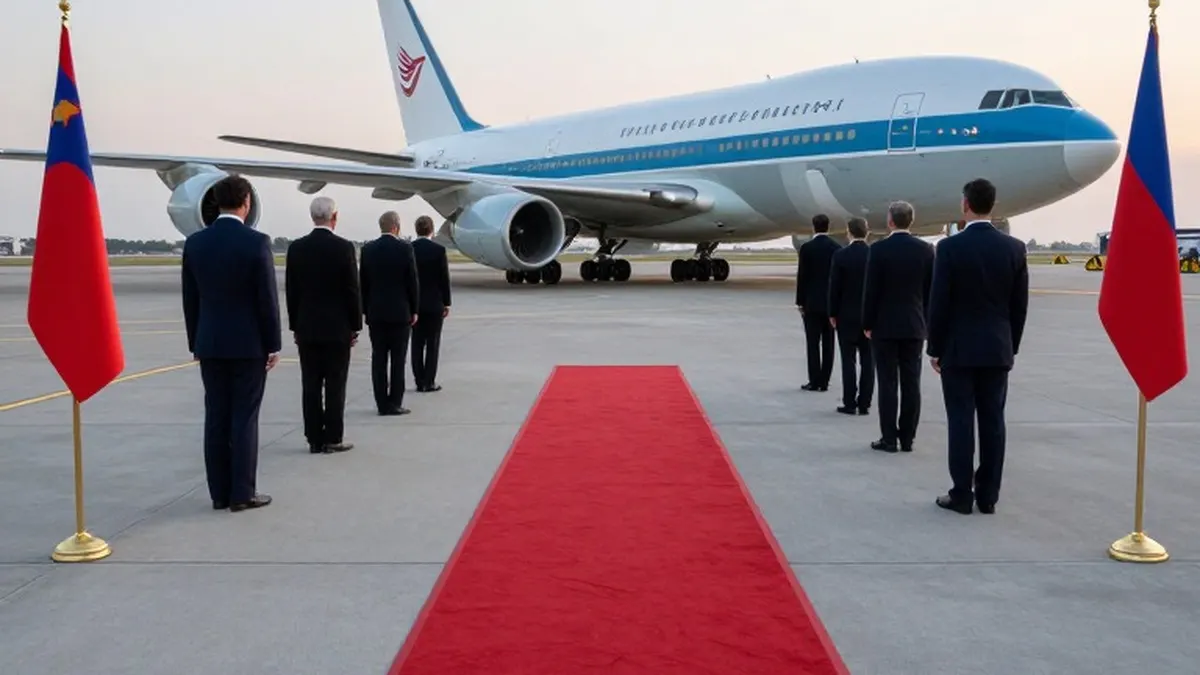
US President Donald Trump arrived in Shenzhen, China, on Wednesday for his third in-person meeting with Chinese President Xi Jinping. This visit marks the third direct diplomatic engagement between the two leaders since they paused the intense trade war that erupted last year. While the Chinese president greeted Trump at the airport, a gesture that is rare for visiting heads of state, observers remain skeptical that the summit will yield significant new deals.
The meetings are taking place on the sidelines of the Asia Pacific Economic Cooperation summit. Analysts suggest that the primary goal is to stabilize relations between Washington and Beijing. This stabilization is critical at a moment when differences between the two powers are highly visible, particularly following recent allegations that a former executive at chip giant Nvidia was targeted in a Chinese espionage operation.
Ryan Hass, director of the John L Thornton China Center at Brookings, noted that both leaders benefit from projecting control over the relationship. However, he warned that their ability to manage these ties may face challenges in the coming year, as opportunities for direct leader level diplomacy are expected to decrease compared to the frequency seen in 2026.
The Nvidia controversy has added complexity to the diplomatic landscape. The scandal involves former Nvidia CEO Jensen Huang and a Megaspeed executive accused of being a Chinese spy. There are suspicions that Megaspeed, a data center company based in Singapore, diverted Nvidia graphics processing units to China in violation of US export controls. US prosecutors confirmed on Monday that a criminal investigation into Megaspeed has been opened.
Trump has attempted to downplay the issue ahead of the talks, stating that he did not want to insult China immediately before his arrival. He is also scheduled to join an unprecedented three-way meeting with Xi and Russian President Vladimir Putin during the APEC summit. Beijing has denied the spying claims, describing them as entirely groundless and intended to malign the country. Rana Mitter from Harvard University expects little public mention of Nvidia, noting that the US administration remains divided on its best course of action.
The current trade truce, which was established in Busan, South Korea, last October, is set to expire on January 10, 2027. During the peak of the previous conflict, tariff rates on Chinese and US goods reached as high as 145 percent and 125 percent, respectively. In his opening address to the APEC summit on Wednesday, Xi urged nations to support free and open trade while opposing protectionism and unilateralism.
Wang Wen, dean of the School of Global Leadership at Renmin University of China, stated that the main focus of the meeting is managing risks among major powers rather than producing sweeping agreements. He added that China aims to steer relations toward mutual respect and peaceful coexistence to avoid a Cold War style bloc confrontation.
While the previous meeting in Washington produced a few tangible outcomes, including commitments to lower tariffs on 60 billion dollars worth of goods, major areas of contention remain. China's restriction on rare earth exports to the US is a significant issue, with current levels reported to be about 75 percent below normal according to the Center for Strategic and International Studies.
Deborah Elms of the Hinrich Foundation noted that recent events, including US midterm election results and the Nvidia fallout, have dimmed expectations for the talks. She suggested that if the leaders simply shake hands without incident, it will be viewed as a success. She also pointed to growing uncertainty within the US regarding its position on China, exacerbated by disagreements among Trump's own team.
Dennis Wilder, a former US national security official, indicated that the leaders have limited time for substantive discussion, with talks expected to last only about two hours. He believes they are unlikely to announce an extension of the trade truce at this summit. Wilder expects the Chinese to voice concerns over new high technology export controls, while the US will raise issues regarding agricultural imports and rare earth exports. The overall goal for Trump is to maintain the strategic stability announced during the Washington summit.