Fargo brewer hits 2,000 daily bottles as non-alcoholic demand surges
Bob Adler’s operation at Fifth Street North is struggling to keep up with orders for the pasteurized beverage that tastes like beer but contains no alcohol.
By Yuki Melnyk ·
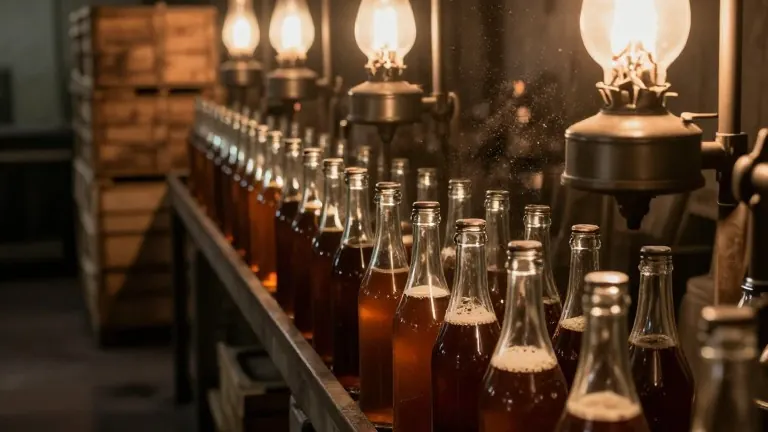
Bob Adler’s operation at the Fargo Bottling Works is currently producing 2,000 quart bottles of Cream Malt every day. According to Adler, the facility is unable to keep pace with incoming orders for the non-alcoholic beverage. The output figure represents the current daily limit for the department he oversees. Fifteen men are permanently assigned to the production line for this specific product.
The beverage is distinct because it mimics the flavor of beer without the alcohol. Adler claims the drink can sober a intoxicated man without the drinker realizing they are consuming a non-intoxicating liquid. This characteristic has made it a useful tool for prohibition workers in the region. The product is described as a recent discovery that is gaining popularity rapidly.
The manufacturing process relies on a specific pasteurization method. The malt is brewed in the East using pure malt and hops, then shipped to Fargo in large casks. Once in the city, every bottle is sterilized and pasteurized under Adler’s direct supervision. This step is identified as the secret to the beverage's success. Pasteurization involves boiling the brew at a precise temperature and cooling it properly to prevent fermentation or souring.
Adler noted that the secret was originally held by Louis Pasteur. Large brewers eventually pooled resources to pay Pasteur $100,000 in cash for the rights to the method. This acquisition allowed the major brewing companies to standardize the process. The technique guarantees that the final product contains no alcohol.
R. R. Adler returned to Fargo about a year ago to take charge of the Malt Cream department. He joined the Fargo Bottling Works after the company completed a new building on Fifth Street North. Prior to this role, Adler lived in Moorhead. He had previously managed a wholesale liquor house in Fargo from 1881 to 1886. That business, Kohn & Adler, operated opposite the Great Northern depot. The building where it was located later became the Masonic Temple before being destroyed in a fire in 1893.
Adler arrived in Fargo in 1880. He built a large white brick block where the Masonic Temple currently stands. After his liquor business failed in 1886, he moved to Moorhead. During his time there, he partnered with Jake Hiensferter in wholesale liquors. Hiensferter later ran a drug store in Fargo and is now with E. E. Hazen in Chicago. That Chicago factory is currently producing Castoria at full capacity. Adler also retains the agency for the Brunswick-Balke-Collender Co., which manufactures billiard and poolroom equipment.
The Fargo Bottling Works is led by Hon. Finn Leech, who serves as president. Leech was recently elected to the state legislature. Adler joked that the laws Leech does not pass will not be useful. H. L. Blout serves as the secretary and treasurer of the establishment. Blout also operates a cigar store on Broadway where he sells tobacco and cigars. Adler described himself as an old timer who works constantly. He said he has forgotten his old habits and now spends his evenings either at home or at the factory putting up additional bottles.
The current production run is driven by the need to meet growing consumer demand. The facility uses its entire basement for the manufacture of Cream Malt. Every bottle is sealed under the care and direction of Adler. The business model reflects the old school of Fargo commerce where money is made and spent actively. Adler stated that if people knew he owned the business, they would assume he stole it, similar to the perception surrounding the Edwards Building when it was first constructed.
The operation continues to expand its presence in the local market. The non-intoxicating nature of the drink appeals to a specific segment of the population. The pasteurization process remains the central technical advantage for the product. The facility is located in a new building on Fifth Street North. The daily output of 2,000 bottles is a fixed number for now. The fifteen employees on the line are dedicated to this single task. The shipment of malt from the East arrives in large casks. The sterilization process happens locally. The final product is ready for sale.
More Business · Scam Watch · Report a business · Got a Story?