Macron's Government Orders 70,000 Officers onto Streets as School Protests Swell
Crowds in Paris, Lyon and Marseille clashed with police on Saturday after the president restricted demonstrations outside union-led marches.
By Yuki Melnyk ·
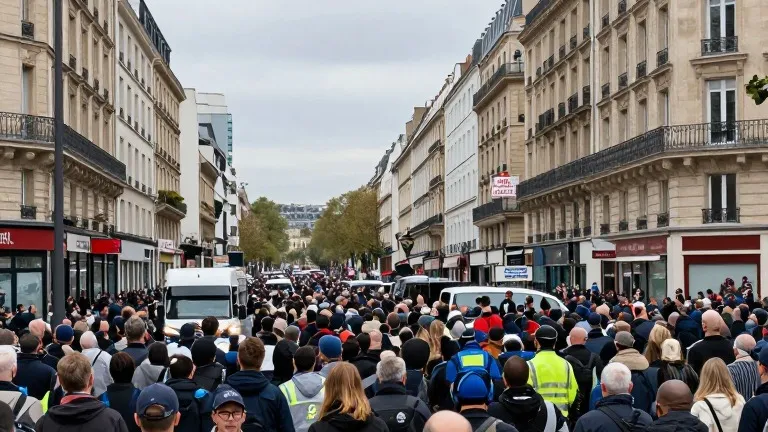
France deployed more than 70,000 police officers on Saturday to cover marches that the government estimated drew at least 400,000 people nationwide.
The government estimated at least 110,000 people marched in Paris along the city's eastern edge. Trade unions put the national turnout at double the government's figure. Shops boarded up and many museums closed for the day. In the afternoon, brass bands played and children walked alongside adults in the crowd. Banners read "Oppression breeds rebellion" and "The right to protest".
The crisis began in mid-September, when students aged 15 to 18 protested staff shortages, leaking and crumbling buildings, and a lack of chairs in overcrowded classrooms. Trade unions, teachers and parents joined the movement in the weeks that followed. Last Saturday, despite peaceful marches elsewhere, France saw one of its most violent days of unrest in years: public buildings burned, hundreds of shops destroyed and looted, and at least 2,700 people arrested.
Tension returned at Porte de Vincennes on Paris's eastern edge at the end of Saturday's route, where groups of masked men in black who had not joined the march threw glass bottles and stones at police. Officers answered with teargas, water cannon and stun grenades. A bin burned and fireworks flew toward police lines. Teargas was also used to keep protesters from reaching city centers in Lyon, Lille, Montpellier, Nantes and Toulouse, while bin fires burned during clashes in Marseille.
President Emmanuel Macron's government banned demonstrations it called "illegitimate" if they were not union-led, and kept marchers away from city centers. Nadège, a 43-year-old communications worker, said she had been teargassed at a peaceful demonstration the previous weekend. "I'm out again peacefully today to support everyone who is brave enough to demonstrate. It does take courage. People are afraid now," she said. "In France, it's our legal right to protest in the street and I'm here to defend that."
Jérôme Rodrigues, a figure from the gilets jaunes protests of 2018 and 2019, said demonstrators were being pushed "to the edge of the city, away from places of power" and that demonstrations were likely to continue each weekend. Some marchers wore yellow vests recalling those earlier protests. In Orléans, thousands marched against a congress held by Marine Le Pen's National Rally party, chanting "Macron, resign. Le Pen in prison." Le Pen is a frontrunner in next year's presidential election, and Macron steps down next year.
Interior Minister Laurent Nunez said 135 people had been arrested across France. Weapons confiscated included metal balls, lead pellets, fireworks, slingshots, steel balls, improvised weapons, a katana sword and airsoft weapons. Police investigations are under way after some children and protesters were maimed and injured by explosive police weaponry. The government had feared a repeat of the previous Saturday's unrest, when public buildings burned and hundreds of shops were destroyed and looted.
Source: The Guardian