China and India waste record solar and wind output due to grid limits
The International Energy Agency says annual grid spending must rise 50% to meet 2030 demand, but current investment lags far behind the rapid expansion of renewable energy sources.
By Yuki Melnyk ·
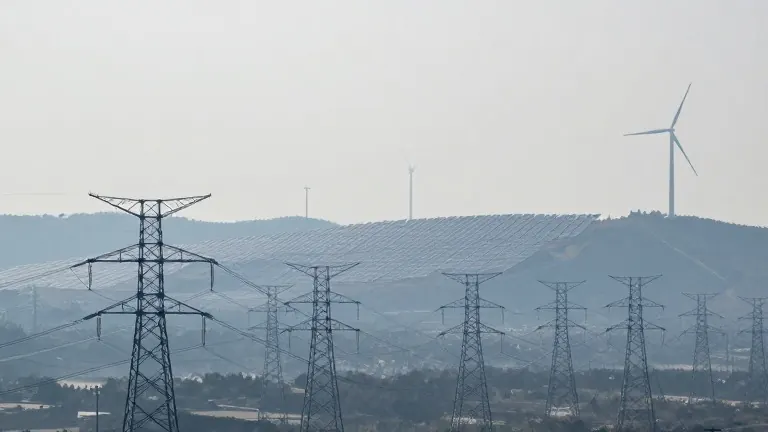
China curtailed 360 terawatt-hours of wind and solar electricity in the first half of 2026, an amount close to the United Kingdom's annual electricity demand. India curtailed 11 terawatt-hours of solar generation over a 15-month period spanning 2025 and 2026, enough power to supply roughly 10 million homes. These figures, cited by the Global Energy Monitor, the Center for Research on Energy and Clean Air, and the think tank Ember, illustrate a growing bottleneck in the global energy transition.
Outdated power grids are struggling to absorb the surge of electricity from new renewable sources. Many existing systems were designed for one-way flow from large centralized plants to consumers. They lack the flexibility to handle the two-way flow and variable output of modern solar and wind farms. When these grids reach maximum capacity, operators instruct renewable farms to limit their output, a process known as curtailment.
The International Energy Agency reports that annual investment in electricity generation has risen by almost 70% since 2015, reaching $1 trillion per year. However, annual spending on grids has increased at less than half that rate. Currently, global grid investment stands at $400 billion annually. To meet electricity demand through 2030, the IEA calculates this figure must increase by approximately 50%.
Negotiations are underway at United Nations climate talks in Antalya, Turkey, where organizers describe modern electric grids as the backbone of the clean energy system. Selwin Hart, a special adviser to the U.N. secretary-general on climate action, stated that massive scaling of grid investment is necessary to meet climate and development goals. He noted that while the long-term trend favors energy transition acceleration, infrastructure and storage must keep pace.
Jan Rosenow, a professor of energy and climate policy at Oxford University, said that past complacency has turned the grid into a real bottleneck. Power grids have not been readied for the scale of renewable electricity generation. James Abraham of the Council on Energy, Environment and Water in New Delhi emphasized that transitioning away from fossil fuels requires a complete grid transformation.
The urgency of grid upgrades has increased following the Iran war, which created energy security concerns in regions such as Southeast Asia. The United Nations launched a Global Grids Accelerator during the General Assembly in September to speed up funding for electricity infrastructure in Africa and Southeast Asia. Gahee Han of Solutions for Our Climate warned that without upgrades, Asian nations may be forced to rely on conventional gas and coal plants.
The Association of Southeast Asian Nations is promoting an interconnected power grid to allow countries to trade electricity more easily. Abdul Razib Dawood, executive director of the ASEAN Center for Energy, said the recent crisis is unifying the region. He described the situation as an opportunity to strengthen regional cooperation through shared energy infrastructure.