Milei bets Argentina's AI future on Patagonia's wind and shale
The president is offering a 15% corporate tax rate to attract massive data centers to remote ranching lands, a move that pits local sheep farmers against a growing environmental backlash.
By Elena Greco ·
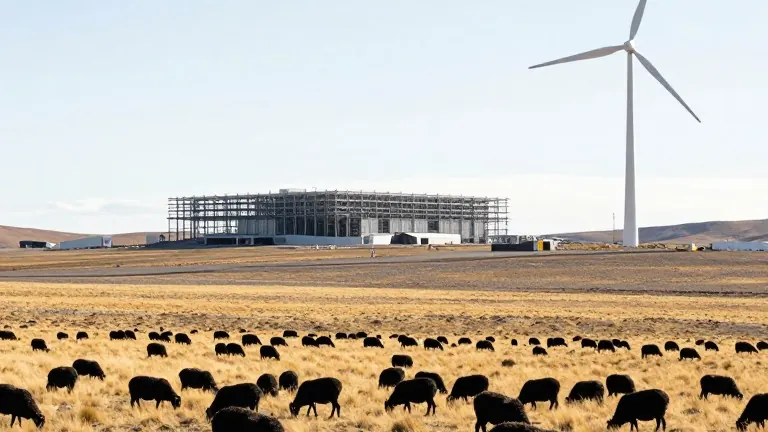
President Javier Milei has formally proposed slashing the corporate income tax rate from 25% to 15% for artificial intelligence projects valued at $1 billion or more, a measure currently awaiting Senate approval. The incentive scheme is designed to attract foreign data center developers to Argentina, a country where residents and policymakers in Europe and the United States are increasingly fighting over the electricity and water usage of such facilities.
Milei has positioned his nation as a regulatory free zone for the industry. Speaking to the U.S. Chamber of Commerce in Washington last month, he stated, "We are not going to regulate artificial intelligence. We are going to leave it free." Visitor logs show that high-profile tech figures, including venture capitalist Peter Thiel and representatives from OpenAI, Amazon, Google, and Oracle, have met with Milei and his aides in recent months.
The strategy relies heavily on the geography of Patagonia. The region offers vast open plains, cold climates for natural cooling, strong winds, and the Vaca Muerta shale deposit. Marta Zlotkowska, head of international development at Green Capital, a Polish renewable energy firm, said her company plans to build a $3 billion data center in Patagonia. She noted that after comparing global locations, Patagonia ranked highest in every category for the project.
Green Capital has secured leases on 130,000 hectares of land from 14 ranchers in Chubut province. Francisco Sáenz, a fourth-generation sheep farmer, is among those who leased land. He noted that the wool industry has declined due to drought and high costs, making the new revenue stream attractive. Construction is not expected to begin until 2028, and the finished campus would consume 2.7 times as much electricity annually as the city of Buenos Aires did in 2025.
The project faces opposition from environmentalists and local residents. Alan Rocha Varsanyi, a researcher at Observatorio Petrolero Sur, argued that the computing capacity will likely be exported to foreign firms rather than serving local technological needs. In Trelew, a small group of residents has formed a coalition called "Trelew Free of Data Centers." Cristina Gibón, 46, a local resident, expressed concern that the project will deplete water resources for future generations.
Critics of Milei's approach warn that a lack of rules could turn Argentina into a testing ground for unregulated AI. Nicolás Wolovick, a computer science professor at the National University of Córdoba, compared the situation to pharmaceutical companies testing new drugs in developing countries. Some investors are also waiting to see the outcome of next year's presidential election, fearing a change in government could reverse free-market reforms.
Milei is set to meet with Pope Leo XIV next week during the pontiff's Latin American tour. The pope has previously warned about the threats AI poses to humanity. In Congress, opposition lawmakers have forced Milei to modify a bill regarding foreign land ownership and have stalled his plan to allow AI agents to control corporations. The debate continues in Chubut, where officials like Andrés Arbeletche insist the region gains everything and gives nothing up, even as environmental studies remain pending.
Source: Greenwich Time
More Business · Scam Watch · Report a business · Got a Story?