Elvis and McDowell: Lunar water caps sustainable settlements at 10,000
Harvard and Durham researchers calculate that existing moon ice reserves support a small town for centuries, but only a million people for a century.
By Yuki Melnyk ·
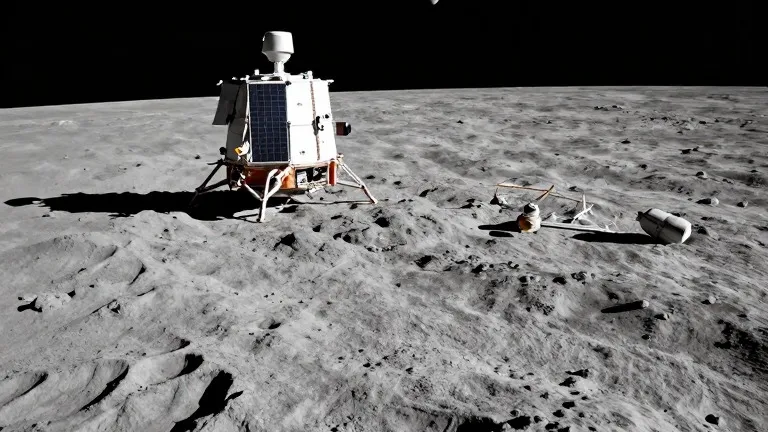
Martin Elvis and Jonathan McDowell published a new analysis in Frontiers in Space Technologies that challenges the scale of proposed lunar cities. The study examines the availability of water on the moon, a critical resource for large-scale human habitation. Their findings suggest that current estimates of lunar water reserves are insufficient to support the millions of residents envisioned by major aerospace executives.
The researchers calculated that a population of one million people could rely on the moon's water for only about 100 years. This projection assumes that 98 percent of the water is recycled, matching the efficiency rate of the International Space Station. The total water available is estimated at roughly one billion tonnes. Elvis noted that this volume is modest, comparing it to a small lake rather than a vast reservoir.
Elvis, a senior astrophysicist at Harvard University's Smithsonian Astrophysical Observatory, and McDowell, an honorary professor at the Durham University Space Research Centre, focused on two primary constraints: power and water. They determined that power generation would not limit settlement size. Solar and nuclear energy sources would be sufficient to sustain one million people on the lunar surface. Water, however, presents a harder physical limit.
A smaller settlement of 10,000 residents would be sustainable for centuries under the same conditions. McDowell stated that covering the moon with large cities requires finding a way to transport water to the surface, as it is not currently present in accessible quantities. He added that the findings should encourage exploration rather than discourage it.
The study's assumptions may be optimistic. Elvis suggested that the one billion tonne estimate could be 20 or 30 times too large. He estimated that only one-third to one-half of the water would be recoverable. His best guess is that the usable amount is about one percent of the original figure, which would reduce the 100-year lifespan to one year.
Gordon Osinski, a professor of planetary geology at Western University in London, Ontario, noted that satellite measurements contain uncertainties. He believes the water exists but requires ground confirmation. Osinski compared the potential ice to Arctic permafrost, describing it as sub-millimetre crystals mixed into soil that are difficult to extract.
Source: CBC News