52 vs. 50: Israel's fragmented vote leaves 120-seat Knesset without a clear path to power
Polls show a near-deadlock in Tuesday's election, forcing parties into difficult negotiations over a coalition that may require support from Arab lists or lead to another vote.
By Yuki Melnyk ·
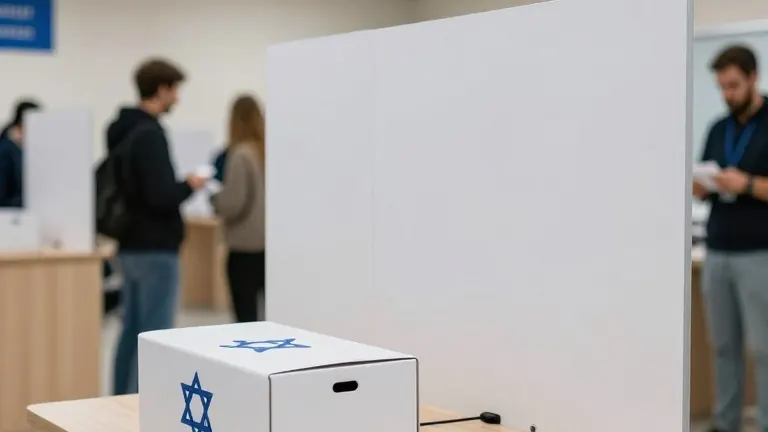
Israelis will cast ballots on Tuesday for the first legislative election since the Hamas-led attacks of October 2023.
The vote determines the direction of a government currently embroiled in multi-year conflicts and facing deep internal division. No single political bloc is projected to secure the 61 seats required for a majority in the 120-seat Knesset.
A poll by public broadcaster KAN, released before a ban on new surveys took effect on Friday, predicts a tight race. The opposition alliance, led by Gadi Eisenkot, Yair Golan, Avigdor Lieberman, and Naftali Bennett, is projected to win 52 seats. Prime Minister Benjamin Netanyahu’s coalition, which includes Likud and far-right partners, is projected to win 50 seats. The remaining 18 seats are expected to go to unaffiliated parties, including the two major Arab lists, Ra’am and the Joint List.
Netanyahu’s bloc includes United Torah Judaism, Shas, Otzma Yehudi, and Religious Zionism-Zehut. The opposition side comprises the Yashar party, the Democrats, Yisrael Beiteinu, and the Together alliance. Both major camps have stated they will not form a government with the Arab-led parties for now, creating a potential deadlock.
If post-election negotiations fail to produce a majority, Israel could face a minority government dependent on outside support or a second round of elections. Mairav Zonszein, a senior analyst at the International Crisis Group, said the secular and liberal opposition views this vote as the last chance to save Israeli democracy and restore eroded institutions.
Voters are weighing security failures linked to the October 2023 attacks against the rising influence of ultra-Orthodox groups. There is also anger over military exemptions for the ultra-Orthodox and concern about judicial reforms proposed by Netanyahu. Yehouda Shenhav-Shahrabani, an Israeli sociologist, noted that right-wing rhetoric and social strains have accelerated under the current government.
The election comes as Israel’s international standing has deteriorated. Dozens of envoys walked out of the United Nations General Assembly when Netanyahu spoke on September 24. Allies are sanctioning settlements in the West Bank, and many nations are denouncing attacks in Gaza and Lebanon.
Netanyahu, who has served as prime minister for 19 years across two stints, faces scrutiny over the October 7 security failures and corruption charges dating to 2019. A loss would leave him more exposed to his trial, which could result in a prison sentence if he is convicted. His political standing is also complicated by an International Criminal Court arrest warrant for war crimes.
About 7.3 million Israeli citizens are eligible to vote, including 1.2 million Palestinian citizens of Israel. Roughly three million adult Palestinians in Gaza, the West Bank, and East Jerusalem do not have a say in the government that controls their borders and movement. Polling suggests Palestinian turnout could reach 60 percent, with most votes going to the Arab lists.
If turnout reaches 65 percent, Arab parties could win up to 15 seats. Campaigners are targeting 70 percent turnout, a level not seen in decades that would raise the threshold for smaller parties. Last month, the Central Elections Committee voted to bar the Joint List and Ra’am, but the top court reversed the decision. The court did force Balad leader Sami Abu Shehadeh to withdraw after he described the October 7 attacks as an important historical event. Joseph Mansour, a former aide to Knesset member Ayman Odeh, wrote that a deadlock where the opposition falls short of 61 seats could allow Netanyahu to remain in office as a caretaker prime minister.
Source: Al Jazeera