Israelis vote in tight race focused on Netanyahu's 19 years in power
Polls show a near-dead heat between pro and anti-Netanyahu blocs, with the result potentially hinging on a single seat in the 120-member Knesset.
By Elena Greco ·
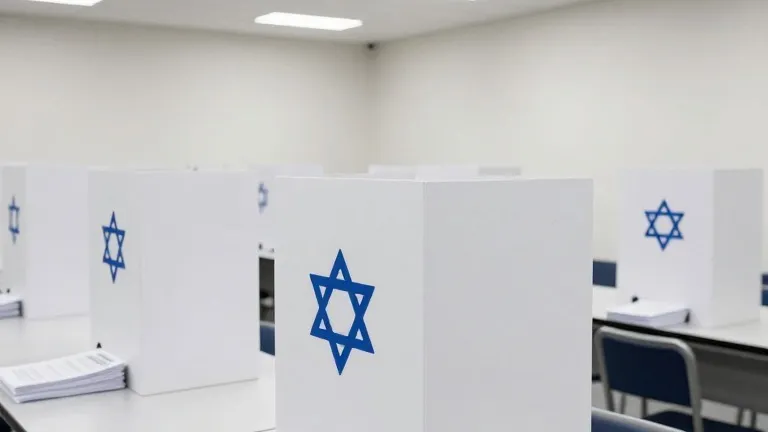
Voters in Israel cast ballots on Tuesday in a Knesset election that hinges less on ideological divides and more on the political future of Benjamin Netanyahu. He has served as prime minister for 19 of the last 30 years, and current polling indicates the country is split evenly between those supporting him and those opposing his continued tenure.
The main challenger is Gadi Eisenkot, a former Israel Defense Forces chief of staff who entered politics four years ago. At a rally in Modi'in, attendees praised his direct style. Noa Sadeh, a 56-year-old supporter, said she is tired of politicians who only know how to speak and wants someone who will actually work.
Eisenkot proposes US-style term limits for prime ministers, arguing that power corrupts. His party, Yashar, which means straight or direct, seeks to establish a government without lies. The opposition bloc also includes former prime minister Naftali Bennett and Avigdor Lieberman, both of whom previously served under Netanyahu before breaking with him.
On the right, Itamar Ben-Gvir's party argued that Netanyahu drifts left and must be pulled right. Yishai Fleisher, a party member, told voters in Bet Shemesh that they need more settlements in the West Bank and Gaza, a ministry to encourage voluntary Palestinian departure, and the death penalty.
Netanyahu's campaign has framed the choice as a binary between the right and Palestine. His posters place opposition leaders next to the heads of parties representing Palestinian citizens, who comprise about one-fifth of the population. The central question for voters is whether the anti-Netanyahu Jewish parties, who are forecast to outpoll his bloc but lack a majority, will rely on Arab parties to form a government.
Tensions rose this week when Yinon Magal, a host on Channel 14, called Eisenkot a Moroccan monkey. While Eisenkot did not repeat the slur at his rally, the incident divided observers. Some viewed his silence as restraint, while others criticized him for not forcefully attacking his main opponent.
Observers question how Netanyahu remains a strong contender given recent events. The deadliest attack in Israel's history occurred on 7 October 2023 under his watch. His war in Gaza has killed more than 70,000 Palestinians, a third of whom Israel identifies as Hamas combatants, yet Hamas has not been eradicated. He also faces a corruption trial and the fallout from his attempt to curb the supreme court.
Despite these challenges, Netanyahu's loyal base remains intact. His allies claim that military and intelligence chiefs kept him uninformed about the 2023 attack, a claim that lacks evidence. Opposition hopes rely on liberal expatriates flying home to vote, a group that pollsters do not capture. If the election is decided by a single one of the 120 seats, these voters could be decisive.
Source: The Guardian